October 28, 2026, Palais des Nations, Geneva, Switzerland
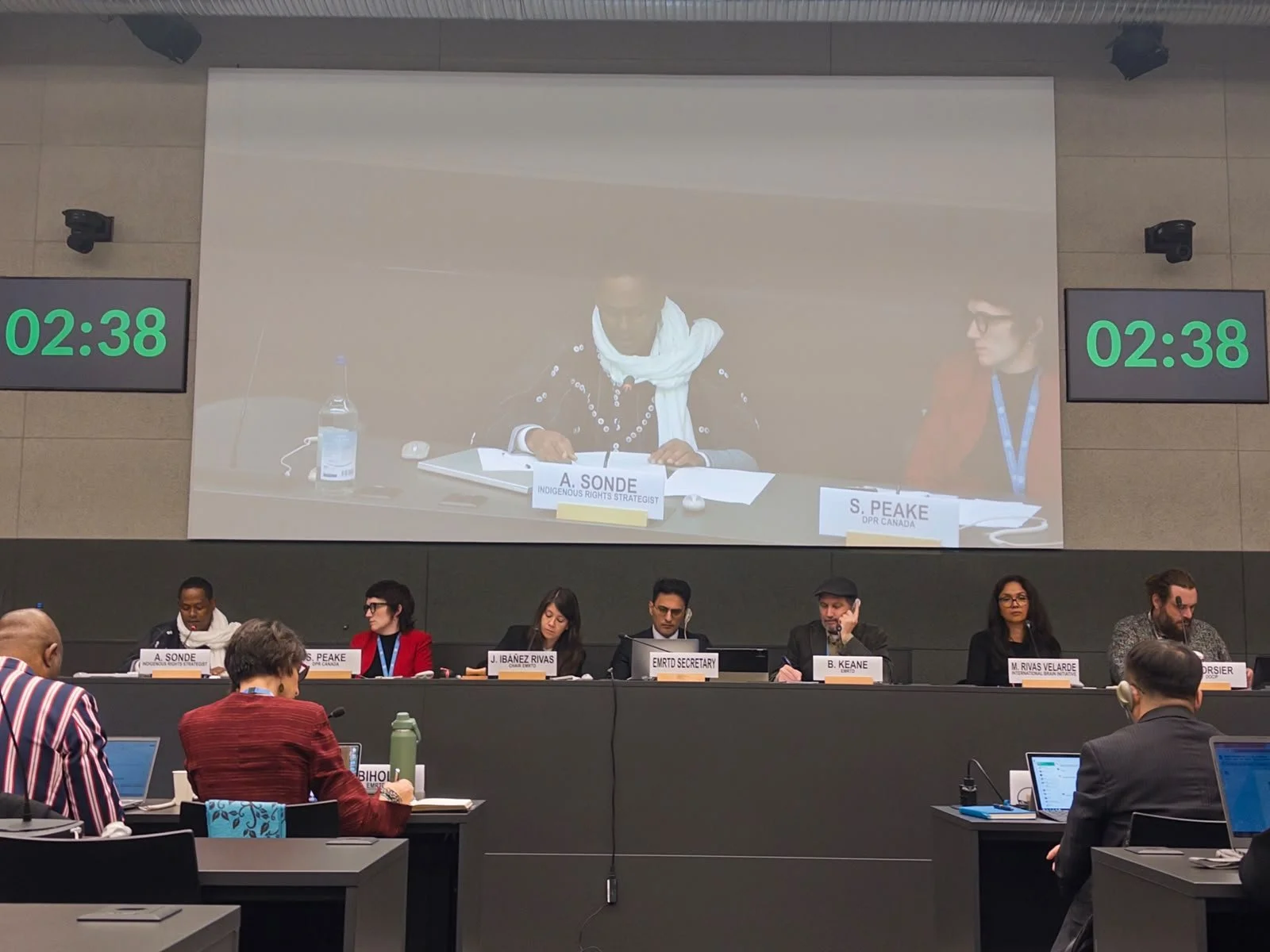
The Expert Mechanism on the Right to Development (EMRTD) held its fourteenth session in Geneva, Switzerland. The session marked the fortieth anniversary of the United Nations Declaration on the Right to Development, adopted by the General Assembly in resolution 41/128 of 4 December 1986. Prof. Minerva Rivas Velarde, Chair of the IBI Crosscultural Working Group, was invited as a panellist in the focused discussion on Indigenous Peoples and the Right to Development. EMRTD member Brian Keane introduced the panel. Fellow panellists included Sharon Peake, Deputy Permanent Representative of Canada; Rémi Orsier of the Indigenous Peoples’ Centre for Documentation, Research and Information; Antine Sonde, Indigenous Representative from Burkina Faso; Valmaine Toki, Chair of the UN Expert Mechanism on the Rights of Indigenous Peoples; and Aluki Kotierk, Chair of the UN Permanent Forum on Indigenous Issues.
Prof. Rivas Velarde was asked what it would take for research and technology development to respect Indigenous data sovereignty and to treat Indigenous Peoples as rights holders. She described Indigenous Peoples as extending their guardianship role into a new domain: protecting the right to choose and control data and to give it meaning, a right now under pressure from the fast uptake of AI-powered tools. She argued that Indigenous knowledge should guide the governance of these technologies rather than appear as an afterthought, and that while the ethical and legal foundations already exist, implementation is lagging.
Her recommendations to States and standard-setting bodies were:
Guarantee Indigenous participation with equal authority from the moment the mandates, membership and procedures of new AI and technology bodies are set.
Develop adapted consent mechanisms, including collective decision-making and ongoing rights of withdrawal, across the whole data and AI lifecycle.
Build sovereignty into operational rules on accountability, oversight, audit and benefit-sharing.
Recognise Indigenous Peoples’ organisations as co-regulators instead of stakeholders, and invest in digital access and the Indigenous institutions that make legal recognition meaningful.
The intervention continues the Working Group’s engagement with the EMRTD. This follows the side event the two co-organized at HRC61 in March 2026, whose contributions feed into the EMRTD’s ongoing thematic study on Artificial Intelligence, Cultural Rights and the Right to Development. At the session’s close, the EMRTD announced that its fifteenth session will take place in New York from April 27 to 29, 2027.
Meeting resources:
The video recordings and transcripts of the Oct 28th morning session are available here: https://transcripts.un.org/en/asset/k14/k14lrxnn2c
Meeting summaries are also available here:
https://www.ungeneva.org/en/news-media/meeting-summary/2026/10/expert-mechanism-right-development-concludes-fourteenth-session