Neurodiplomacy: Global leaders convene at the UNESCO House to advance brain health as a 21st-century priority
Authors: Drs. Agustin Ibanez & Alfred K. Njamnshi, on behalf of the IBI Neurodiplomacy Working Group
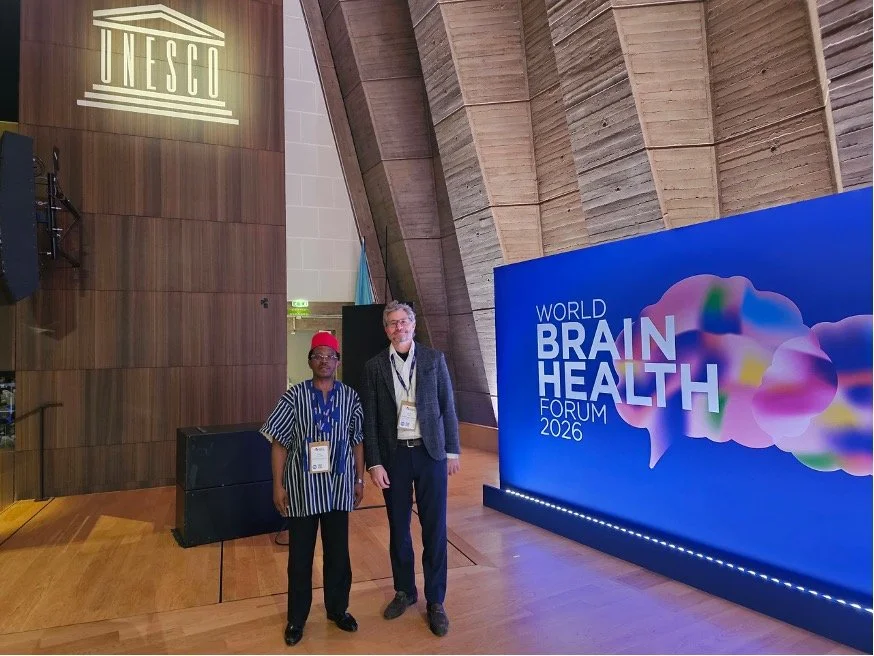
The UNESCO House in Paris hosted a landmark international neurodiplomatic gathering that placed brain health at the center of the global scientific and policy agenda. The World Brain Health Forum, co-organized by the Paris Brain Institute and the Vascular Brain Health Institute, brought together world leaders, senior policymakers, representatives of international organizations, and leading scientists to address one of the most pressing challenges of our time: protecting, promoting, and providing brain health across the lifespan in an increasingly complex world.
From the outset, the Forum set an ambitious tone. Brain disorders—including neurological and mental health conditions—now affect one in three people worldwide and are among the leading causes of disability and mortality. Beyond their medical burden, these conditions undermine education systems, productivity, social cohesion, and democratic resilience. Against this backdrop, the Forum emphasized that brain health must be understood not only as a clinical concern but also as a foundational pillar of sustainable development.
The significance of the Forum was clear from its opening session, which featured keynote addresses by Ban Ki-moon, Secretary-General Emeritus of the United Nations; Tedros Adhanom Ghebreyesus, Director-General of the World Health Organization; Philippe Baptiste, French Minister of Higher Education and Research and Space, and globally renowned scientists, including Philippe Aghion, a Nobel Laureate in Economics. All converged on a central message: neurological and mental health disorders already affect one in three people worldwide and pose a direct threat not only to health systems but also to economic development, social cohesion, and democratic vitality.
Throughout the two days at the UNESCO House and at the Paris Science Academy building, the Forum highlighted a shared conviction: the future of brain health depends on integration. Participants examined how advances in neuroscience, neuroimaging, artificial intelligence, genomics, and data science can be combined with insights from social and environmental research to generate more effective, preventive, and equitable approaches. Panels and discussions repeatedly underscored that fragmented research and isolated interventions are no longer sufficient to meet the scale and complexity of the challenge.
One of the Forum’s key moments was Agustín Ibáñez's presentation of the concept of the Brain Health Synercome, a member of the event's scientific committee. This framework aims to overcome the current fragmentation in brain research by integrating genetic, molecular, neuroimaging, social and environmental exposome data, and behavioural phenotypes within a dynamic and predictive model. Ibáñez emphasized that the main limitation facing the field today is not a lack of data, but rather their disconnection—severely constraining the ability to anticipate, prevent, or modify trajectories of brain aging and disease. The Synercome was proposed as a new scientific horizon to model the complex, non-linear interactions between biology, environment, social and economic context, while also addressing the strong bias of existing datasets toward high-income populations and promoting inclusive data infrastructures and regional leadership, particularly in the Global South.
The World Brain Health Forum extended well beyond keynote lectures. Across the day, panels addressed prevention, innovative therapies, artificial intelligence, mental health, population aging, and equity, with contributions from experts across Europe, the Americas, Africa, and Asia. A unifying theme was the urgent need to translate scientific evidence into concrete public policies and intervention strategies that reduce inequalities and maximize the societal impact of knowledge. This theme aligns with the Yaoundé Declaration on the brain economy, brain health, and brain capital, highlighted at the UN General Assembly (UNGA) Science Summit Brain Days (UNGA79 & 80), as well as the G7 Brain Economy Summit (Canada) and the G20 Ministerial Meeting Side Event in South Africa. 1,2,3
The Forum also devoted significant attention to translation—how to move from knowledge to action. Sessions explored how brain health can be strengthened through prevention across the life course, how artificial intelligence can accelerate diagnosis and therapy development, and how public–private partnerships can reduce barriers to innovation. Importantly, discussions went beyond technology, emphasizing social determinants such as education, inequality, and environmental exposures as critical drivers of brain health outcomes.
A New Initiative to Strengthen Brain Health in the Global South
At the World Brain Health Forum, a new Fellowship in Brain Health for the Global South was formally established. This international initiative aims to confront profound global inequalities in brain health by training a new generation of leaders and scientists. Led by the Ban Ki-moon Foundation, the Paris Brain Institute, and the Vascular Brain Health Institute, the Fellowship seeks to strengthen local capacity, promote research excellence with social impact, and build global networks where they are most urgently needed. The initiative will also be supported by the Global Brain Health Institute at Trinity College Dublin and by BrainLat at the Universidad Adolfo Ibáñez, consolidating a strategic alliance to advance more equitable brain health worldwide.
The day at UNESCO House delivered a clear message: brain health is no longer solely a medical challenge, but a fundamental pillar of societal futures. The convergence of political leadership, international institutions, and frontier science marks a turning point toward a more integrated, inclusive, and impactful approach—one capable of addressing one of the most urgent challenges of our time.
The World Brain Health Forum concluded with a strong call to action. Building on the momentum generated at UNESCO House, participants committed to developing strategic directions and policy-relevant frameworks to guide global investment, research coordination, and public health initiatives, firmly anchoring brain health within the global policy discourse (Fig 1).
Footnote:
IBI’s vision is “for border-free global science, scholarship, and innovation for the brain that are catalyzed by the critical engagement of large-scale brain initiatives and unprecedented opportunities for international collaboration.”
References:
Njamnshi AK, Ibanez A, Singh G, Pyykko M, Hachinski V, Eyre HA; Scientific Technical Committee. The Yaoundé Declaration. Lancet Neurol. 2024 Oct;23(10):966-967. doi: 10.1016/S1474-4422(24)00364-8. Epub 2024 Aug 22. PMID: 39182501.
Njamnshi AK, Fame Ndongo J, Ngoh Ngoh F, Mbella Mbella L, Ghogomu PM, Fouda SM, et al. African leadership in brain diplomacy: The Yaoundé declaration advances the global brain economy playbook for better brain health. Neuroscience. 2025 Jun 21;577:161-174. doi: 10.1016/j.neuroscience.2025.04.032. Epub 2025 May 6. PMID: 40339899.
Njamnshi AK, Bassetti CLA, Madzvamutse CR, Ayadi R, Korsten L, Vradenburg G and The Africa Task Force on Brain Health. Brain Health Drives the Global Brain Economy and Prosperity. Lancet Reg Health Africa, 2026, in press.