
A conversation with the IBI Crosscultural Working Group on supporting Indigenous scientists in policy and practice
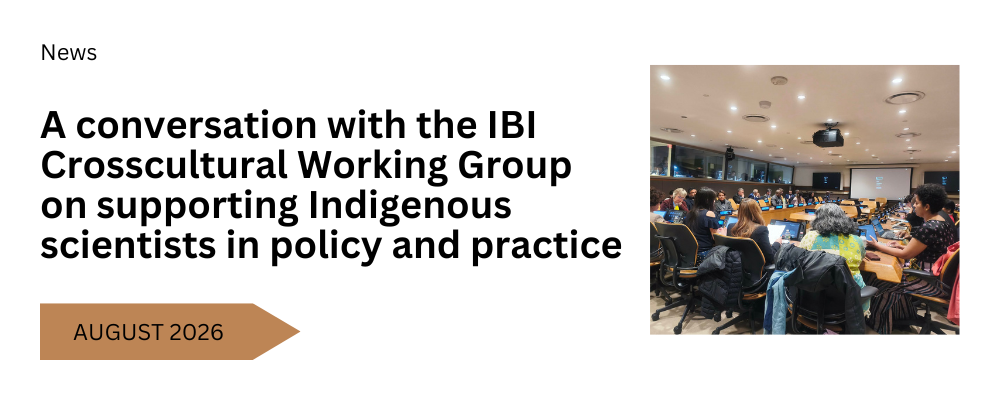
Crosscultural Working Group Chair, Dr. Minerva Rivas Velarde, recently hosted a discussion with Dr. Melissa Perreault on supporting Indigenous scientists in policy and practice. Dr. Perreault, a citizen of the Métis Nation of Ontario, is a translational neuroscientist at the University of Guelph, working across cellular biology, disease mechanisms, and wastewater surveillance, and is a member of the International Brain Initiative's Crosscultural Working Group.
Beyond the monolith: rethinking who belongs in science
Dr. Perreault opened by challenging a common assumption in policy and academic circles: that Indigenous participation in science means looking for Indigenous scientists within the disciplines where they are already expected to be found. She argued instead for actively seeking Indigenous voices in fields where they are least expected, as well as recognizing the value Indigenous community members and leaders bring, independent of academic credentials.
Central to her message is that Indigenous peoples are not a monolith. Using Canada as an example, she pointed to the distinct lived experiences of First Nations, Inuit, and Métis peoples, and noted that these differences multiply further when compared with Indigenous experiences in South America, Australia, Norway, or the Arctic. For Dr. Perreault, meaningfully expanding Indigenous participation in science and policy starts with confronting one's own assumptions about what Indigenous people "are," and making space for the full diversity of that reality.
She illustrated this with the story of an Indigenous high school student who told her she'd felt something was "wrong" with her for wanting to become a chemist, rather than pursuing a more expected path. For Dr. Perreault, this kind of pigeon-holing places an unfair burden on young people and overlooks a simple truth: Indigenous scientists bring their culture into whatever discipline they choose, whether or not that discipline is where policymakers or institutions expect to find them.
Naming the barriers: epistemic arrogance and institutional pressure
Asked how this awareness could be built among policymakers and institutions, Dr. Perreault was candid: academia, in her view, is not yet at that stage. She described a persistent "epistemic arrogance" within academic institutions, and the difficulty of shifting entrenched, one-dimensional expectations of what Indigenous scholars are supposed to study or contribute.
‘I don't think scientists and academics fully appreciate Indigenous diversity. Academic institutions can be very one-dimensional, with a single view of what Indigenous people are "supposed" to do. Until academics, scientists, and institutions come to the realisation that we can do more than they assume, I'm not sure how we get to the stage of engaging with politicians and government.
That requires self-reflection — looking inward at their own biases — and that is not easy.
She linked this directly to career pressures within the scientific system — the need to publish, secure funding, and earn tenure within conventional frameworks — which she said pushed her, like many others, toward safer, more traditional methodologies early in her career. It was only after achieving tenure that she began integrating Indigenous ways of knowing into her research program. She was clear-eyed about the structural nature of the problem, while remaining optimistic that change — however slow — is underway, particularly among younger researchers and students who she finds far more open to these ideas than her own generation.
An extraordinary seat at the UN table
Dr. Perreault described her experience representing Indigenous perspectives at the UN as extraordinary — a rare setting where she did not need an ally's voice to have her own message heard and respected.
‘I felt the message I gave was understood and received’
She contrasted this with her more typical professional environments, where allies are often necessary to help her message land. Being in a room where her voice required no such mediation, she said, was both rewarding and, in her words, simply "felt good."
That experience had a lasting effect beyond the policy sphere. Dr. Perreault noted it strengthened her resolve to integrate Indigenous knowledge not only into advocacy work, but directly into her own translational neuroscience research program — despite the personal costs that can come with doing so in fields still rooted in a single, uniform way of thinking.
She also observed an inversion of a familiar pattern: while in fields like global health, science typically outpaces policy, in neuroscience she sees the reverse — clinical neuroscientists and policy actors moving ahead on the value of cultural humility and diverse ways of knowing, while fundamental and translational neuroscience lags behind.
Collaboration with the IBI
For Dr. Perreault, the most enriching part of working with the IBI has been its genuine global connectivity — the ability to connect with researchers and communities across cultures and geographies in a way that few national organizations can offer. While her own research and advocacy centers on Indigenous peoples in Canada, she expressed a sincere interest in learning from Indigenous communities worldwide, describing a shared thread of commonality across diverse Indigenous experiences globally.
Looking ahead: advice for the IBI's next five years
Dr. Perreault's advice for the IBI centered on two priorities: sustaining its global reach and deepening its investment in early-career researchers. She encouraged the IBI to continue reaching outward rather than centering on any single region, so that voices from across the world can come together around shared policy goals.
She also urged the IBI to widen its net beyond those already engaged in policy work, pointing to her own past experiences as an early-career investigator who did not initially see how her voice could contribute to policy discussions. She proposed that the Crosscultural Working Group's existing fellowship could be used to bring in a fellow from fundamental science — someone without a policy background, but with both the interest and the desire for that exposure.
‘We are diverse, but there are so many commonalities between our peoples. I hope the IBI keeps reaching out to people across the world so those voices can come together, rather than staying centred on what's happening in one's own place’
Dr. Rivas Velarde closed the conversation by welcoming the proposal, noting the potential to build such an opportunity directly into the Working Group's ongoing fellowship program.